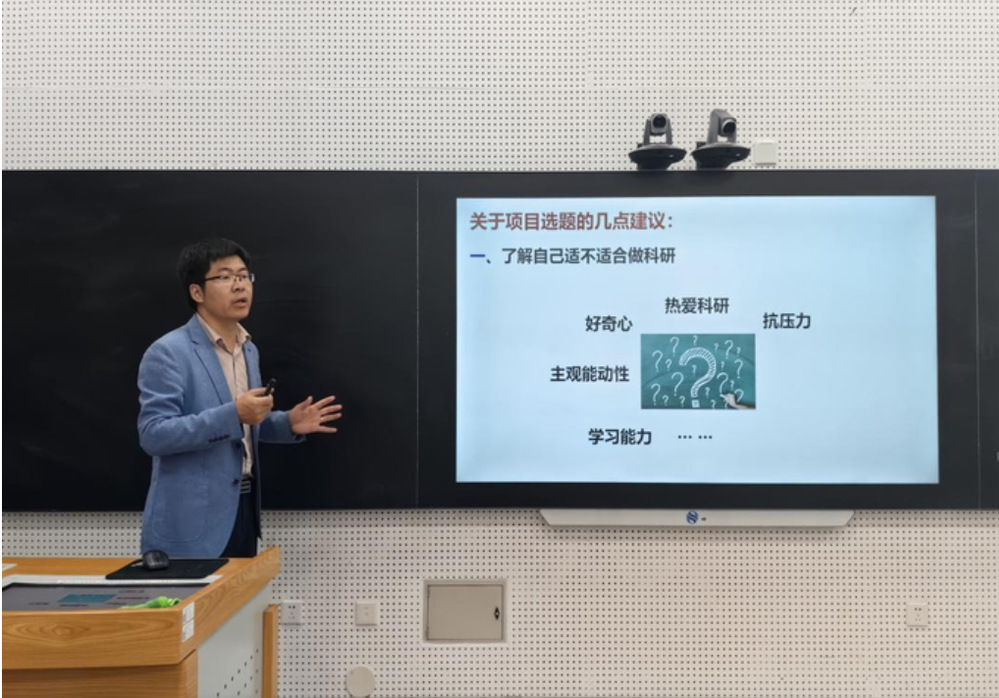
“Science and technology open up new frontiers of knowledge; innovation leads the way.” To promote academic exchange and stimulate innovation, the Science and Technology Innovation Society of the School of Medicine and Health,organized a series of “Second Classroom” activities focused on academic innovation. On the afternoon of October 24, the Society held its first undergraduate, master’s, and doctoral academic salon in Room 106 of the Zhengxin Building. The event featured a presentation by Dr. Li Kai, a doctoral advisor at the School, on the topic “Strategies for Selecting Research Topics in Scientific Research and Innovation Competitions.”
Professor Li Kai’s presentation covered the entire process from selecting a research topic to its implementation, and how to foster innovation. He emphasized that interest serves as the primary guide for research and the foundation for gaining a deep understanding of a field. Before finalizing a topic, students should assess their own mastery of the subject in light of practical requirements, while also incorporating feedback from faculty and peers as key considerations. Using Professor Zhang Feng, a biomolecular biologist, as an example, Dr. Li Kai recounted his research journey—from the concept that “life can be encoded” to the use of viruses as vectors in optogenetics to introduce exogenous genes into neurons, and finally to the development of the CRISPR/Cas system to enhance gene-editing efficiency. Using vivid examples, Professor Li Kai explained the significance and value of research in the field of molecular biology in an accessible manner, encouraging students to reflect deeply on whether scientific innovation involves exploring uncharted territories, achieving breakthroughs in scientific theory, or fostering interdisciplinary integration. At the conclusion of the seminar, students engaged in a lively discussion with Professor Li, and he provided detailed answers to each of their questions.
Through this event, students not only gained a clear understanding of the uncertainties they currently face in their studies and research but also engaged in deeper reflection on their future development. We hope students will make full use of the Science and Innovation Society’s extracurricular platform to explore different research fields, cultivate professional interests, and become “close friends” with scientific innovation, thereby laying a solid foundation in advance for future careers in new medical and biomedical engineering research.