A team led by Professor Qiang He and YingjieWu from the School of Medicine and Health at Harbin Institute of Technology has developed a tumor microenvironment (TME)-responsive dual-enzymatic flasklike nanobot system capable of positive chemotactic motion along endogenous chemical gradients, thereby achieving enhanced tumor penetration and chemotherapeutic efficacy. The work, entitled “Tumor Microenvironment-Responsive Dual-Enzymatic Flasklike Nanobots for Enhanced Chemotherapy,” has been published in Small.
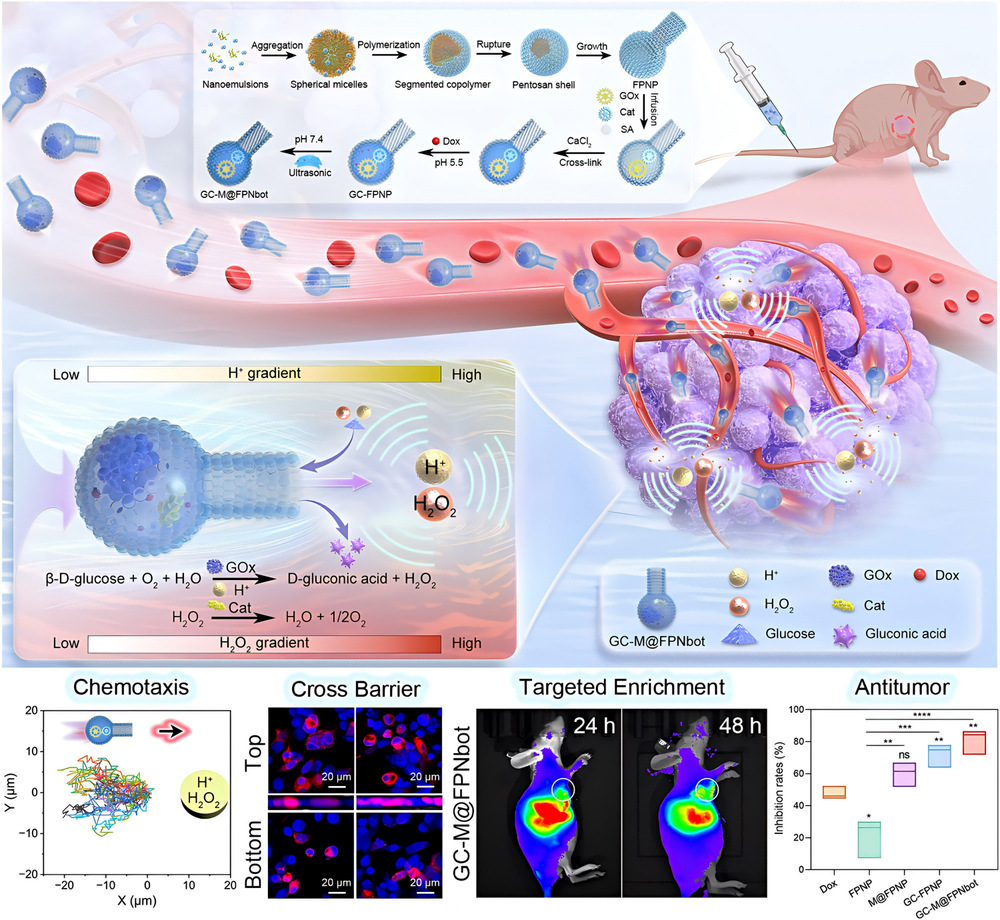
Schematic diagram of flasklike nanobots actively targeting tumors and their therapeutic effects
In solid tumor therapy, conventional chemotherapeutic drugs and passively delivered nanocarriers often fail to effectively penetrate the dense extracellular matrix and the complex TME, resulting in poor intratumoral drug distribution and insufficient accumulation, which severely compromises therapeutic outcomes. Mimicking the active navigation and directional migration behaviors observed in living systems to overcome the multiple physiological barriers posed by the TME remains a core challenge in the field of tumor drug delivery.
Inspired by the presence of biochemical factor gradients within the TME, professor Qiang He's team has developed a TME-responsive dual-enzymatic flasklike nanobot system (GC-M@FPNbot). The nanobots catalyze the decomposition of endogenous glucose (Glucose) and hydrogen peroxide (H2O2) to achieve self-propulsion. By sensing the concentration gradients of protons and H2O2 within the TME, they directionally migrate toward the tumor core, successfully breaching the multiple physiological and microenvironmental barriers and significantly enhancing targeted drug delivery and therapeutic efficacy in tumor tissues.
Harbin Institute of Technology is the first affiliated institution of this work. Professors Yingjie Wu and Qiang He are the corresponding authors. Dr. Qinqin Ruan is the first author. This research was supported by the National Natural Science Foundation of China and other funding sources.
Article link:
https://onlinelibrary.wiley.com/doi/10.1002/smll.202509966