A research team led by Professor Qiang He from the School of Life Science and Medicine at Harbin Institute of Technology has made significant progress in the field of precision therapy for glioblastoma. Inspired by biochemical gradients in the tumor microenvironment, the team developed a self-homing liposomal nanobot with autonomous navigation capability. This nanobot can efficiently deliver therapeutic drugs, actively cross the blood-brain barrier, achieve lysosomal escape, and accumulate at glioblastoma lesions, providing a promising approach for glioblastoma treatment. The work, entitled “A Self-Homing Liposomal Nanobot for Active Therapy of Glioblastoma,” has been published in Angewandte Chemie.
Glioblastoma is one of the most aggressive and deadly tumor types in the central nervous system, yet current clinical outcomes remain far from satisfactory. One of the major challenges in treatment is that the blood-brain barrier, together with the highly complex tumor microenvironment, forms a formidable barrier to drug delivery. As a result, both conventional drugs and nanomedicines often fail to reach tumor lesions efficiently and precisely, greatly limiting therapeutic efficacy.
To address this critical issue, the research team drew inspiration from key biochemical features of the glioblastoma microenvironment, including proton gradients and the overexpression of γ-glutamyl transpeptidase. They fabricated Janus-structured self-homing liposomal nanobots at scale using a multilevel molecular assembly strategy. One side of the nanobot is modified with an enzyme-powered module, which catalyzes the decomposition of endogenous glucose to generate autonomous propulsion, enabling the nanobot to sense proton gradients in the tumor microenvironment and migrate directionally toward the lesion center. The other side is γ-glutamyl-functionalized, allowing it to specifically recognize and bind γ-glutamyl transpeptidase, which is highly expressed on both the blood-brain barrier and tumor cells. This process generates positively charged primary amino groups in situ, thereby triggering adsorption-mediated transcytosis and enabling efficient lysosomal escape through the proton sponge effect. In this way, the nanobot successfully overcomes the multiple barriers posed by the blood-brain barrier and the tumor microenvironment.
In vivo experiments showed that the liposomal nanobot increased drug delivery efficiency by more than fourfold, significantly prolonged median survival, and exhibited favorable biosafety with low toxicity. These results demonstrate its strong potential as an intelligent drug delivery platform for glioblastoma therapy.
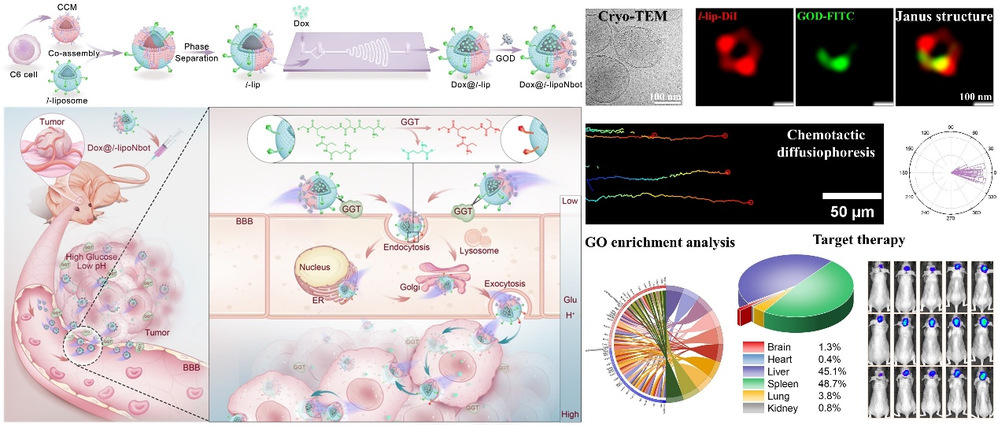
Overview of the design, autonomous navigation, blood-brain barrier penetration, and therapeutic performance of the self-homing liposomal nanobot for glioblastoma treatment
This study proposes an innovative therapeutic strategy that uses the unique biochemical signals of the disease microenvironment to enable autonomous navigation, barrier crossing, and precise drug delivery. With strong generalizability, this strategy may also be extended to the treatment of other central nervous system diseases, such as Alzheimer’s disease and Parkinson’s disease, opening up new avenues for the development of precision medicine.
Harbin Institute of Technology is one of the leading institutions of this work. Professor Qiang He and Researcher Mingjun Xuan from the Wenzhou Institute of the University of Chinese Academy of Sciences are co-corresponding authors. PhD student Yanfang Cheng is the first author, and Associate Researcher Kangning Zhu from the Wenzhou Institute of the University of Chinese Academy of Sciences is co-first author. Professor Yingjie Wu and Associate Researcher Meng Mao from the School of Life Science and Medicine, as well as Researcher Ling Yang from the Wenzhou Institute of the University of Chinese Academy of Sciences, also participated in this research. This work was supported by the National Natural Science Foundation of China and the Key Research and Development Program of Heilongjiang Province, among other funding sources.
Article link:
https://onlinelibrary.wiley.com/doi/10.1002/anie.202512948