Ischemic heart disease (IHD), the leading cause of mortality worldwide, exhibits a distinct spatiotemporal progression of pathological events. In the early stage, oxidative stress burst and mitochondrial dysfunction dominate, triggering multiple forms of cell death. During the transitional stage, damage-associated molecular patterns (DAMPs) initiate chronic inflammation, activating innate immunity and initiating fibrotic processes. In the terminal stage, persistent extracellular matrix imbalance and fibrotic remodeling ultimately lead to cardiac dysfunction. This cascade of oxidative stress, chronic inflammation, and fibrotic remodeling forms a self-perpetuating vicious cycle.
Current clinical interventions mainly focus on restoring blood flow, but they are unable to effectively target the stage-specific pathological mechanisms underlying disease progression. Moreover, conventional pharmacological therapies suffer from poor targeting capability and systemic toxicity. Owing to their tunable physicochemical properties and functional versatility, nanomaterials provide innovative opportunities for lesion-specific targeting, controlled drug release, and multi-mechanism synergistic therapy, offering promising strategies to overcome existing therapeutic limitations and enabling precision management throughout the entire course of IHD.
Recently, the research team led by Prof. Liu Shaoqin and Prof. He Liangcan from Harbin Institute of Technology systematically summarized the key mechanisms underlying the progression of IHD and the current therapeutic strategies. The review particularly focuses on the latest advances in nanomaterials designed to address stage-specific pathological processes, including oxidative stress in the acute phase, inflammation in the transitional phase, and fibrotic remodeling in the late phase. The authors critically analyze the limitations of current technologies and propose future research directions, aiming to provide a systematic theoretical framework and forward-looking design principles for the development and clinical translation of nanotechnology-based therapeutic strategies targeting the entire disease course.
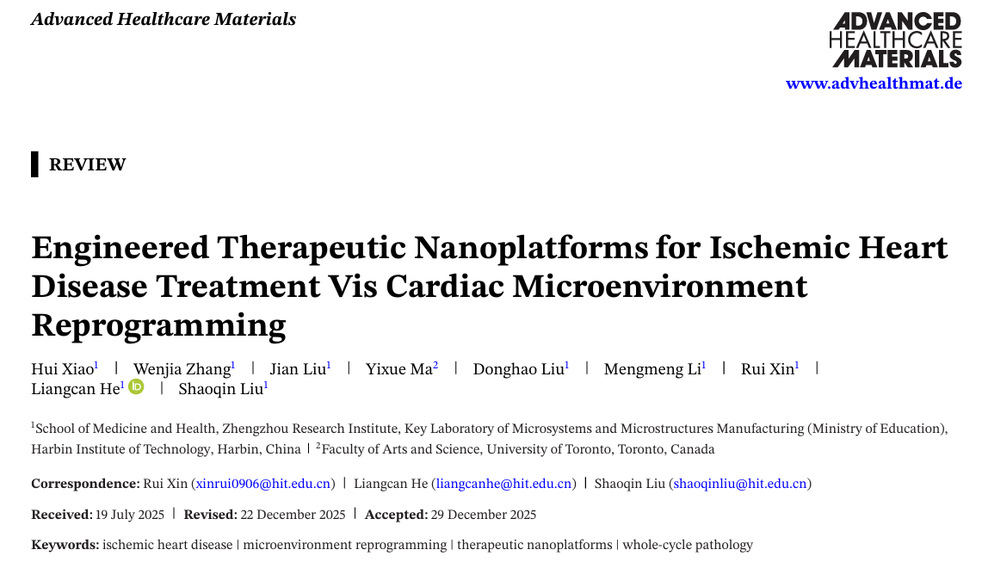
The work was published in Advanced Healthcare Materials under the title:
“Engineered Therapeutic Nanoplatforms for Ischemic Heart Disease Treatment via Cardiac Microenvironment Reprogramming.”
Highlights of the Review
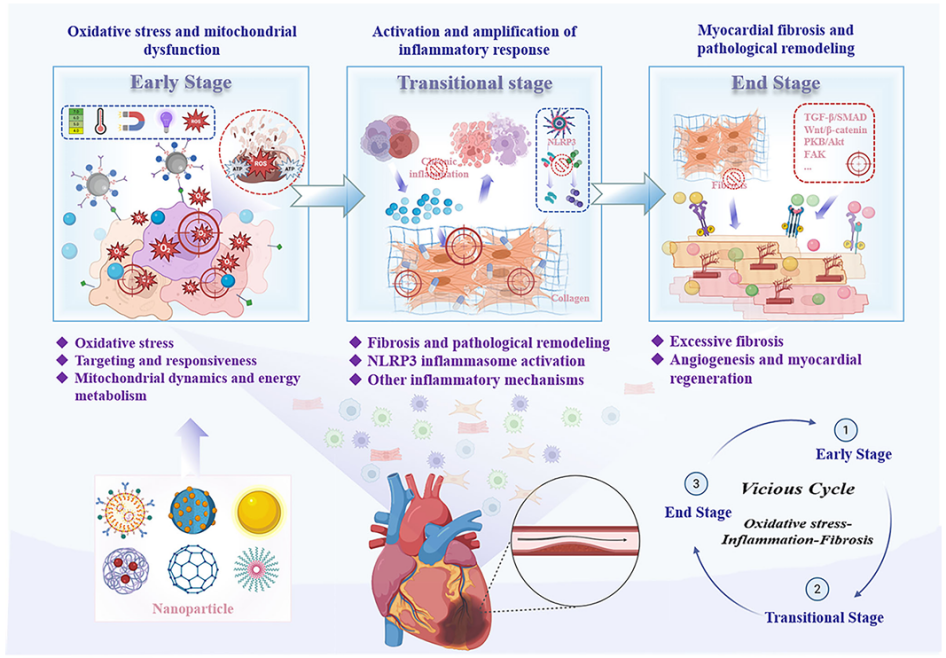
1. The Oxidative Stress–Inflammation–Fibrosis Axis in IHD Progression
Ischemic heart disease progresses through a continuous pathological cascade involving oxidative stress, inflammation, and fibrotic remodeling. In the early phase, ischemia–reperfusion injury disrupts mitochondrial function and leads to excessive reactive oxygen species (ROS) production, triggering cardiomyocyte death. As the disease progresses, DAMPs released from injured tissue activate the innate immune system, promoting inflammatory responses and immune cell activation. Persistent inflammation further stimulates cardiac fibroblast activation and extracellular matrix deposition, leading to ventricular remodeling and heart failure. These interconnected processes form a self-reinforcing pathological loop that drives disease progression.
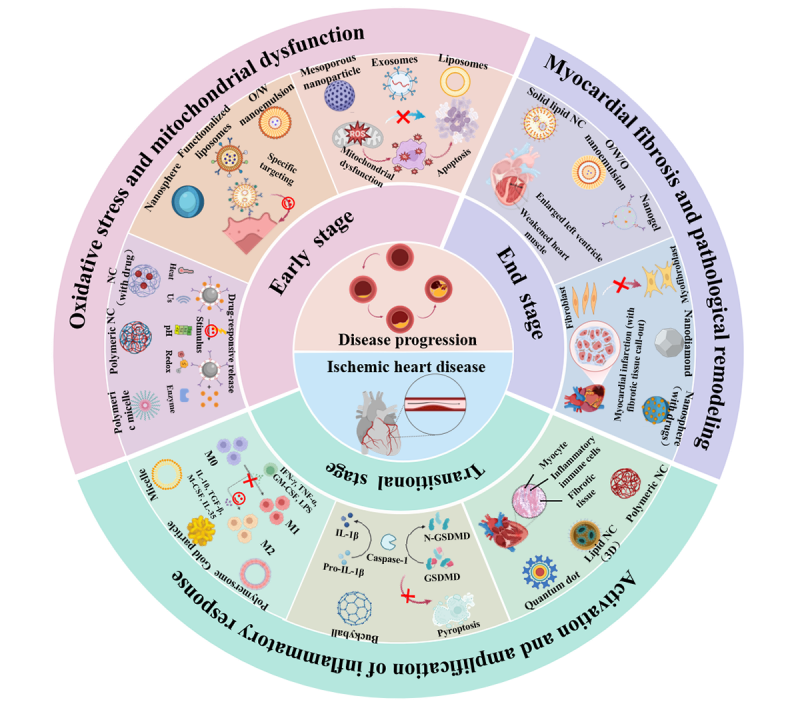
2. Stage-Specific Nanomaterial Strategies for Precision Therapy
Because IHD evolves through distinct pathological stages, nanomaterial-based therapies can be rationally designed to target the dominant mechanisms at each stage. In the early stage, nanoplatforms capable of ROS scavenging, mitochondrial targeting, and responsive drug release can reduce oxidative stress and protect cardiomyocytes. During the intermediate stage, nanomaterials may regulate immune responses by modulating macrophage polarization and inhibiting key inflammatory pathways, thereby preventing the transition from inflammation to fibrosis. In the late stage, targeted delivery systems can inhibit cardiac fibrosis and promote tissue repair, for example by delivering antifibrotic agents or pro-angiogenic factors. These strategies highlight the potential of nanotechnology for precision intervention throughout the entire disease course.
3. Perspectives and Future Directions
Nanotechnology offers significant advantages for the treatment of ischemic heart disease, including targeted drug delivery, microenvironment-responsive release, and multi-functional therapeutic integration. However, several challenges remain, such as improving delivery efficiency, enhancing targeting specificity, and ensuring long-term biosafety. Future research may focus on developing smart nanocarriers, integrating diagnostic and therapeutic functions, and leveraging multi-omics and artificial intelligence to guide nanomedicine design. With continued advances, nanotechnology-based approaches may provide new opportunities for comprehensive and precise management of ischemic heart disease, ultimately improving cardiac repair and functional recovery.
Article link: https://advanced.onlinelibrary.wiley.com/doi/10.1002/adhm.202503560